
Criminal Court Cases in Campbell County
Campbell Circuit Court is the felony trial court for Kentucky's 17th Judicial Circuit. Campbell District Court handles misdemeanors, violations, traffic cases, and the first stage of felony matters. Both record sets are managed by the Office of Circuit Court Clerk at 330 York Street in Newport. The clerk's main line is 859-292-6314. Press 1 for District Court and press 2 for Circuit Court. The narrower published clerk-counter window is 8:30 a.m. to 4 p.m. on weekdays.
That split matters. A misdemeanor can remain in District Court from filing through disposition. A felony often begins as an F case in District Court, where the court handles the initial appearance, bond, and preliminary stage. If a grand jury indicts, a new CR case proceeds in Circuit Court. A complete Campbell County court case lookup may therefore require both numbers.
Campbell County Court Divisions
The court level tells the reader what part of the criminal process the file can prove. The County Attorney's Criminal Division, located on the courthouse third floor, prosecutes county misdemeanors. Felony prosecution after indictment belongs to the Commonwealth's Attorney for the 17th Judicial Circuit. Charging offices can explain their roles, but the Campbell clerk remains the public source for filed pleadings, docket entries, orders, and judgments.
| Court or office | Criminal record role | Contact route |
|---|---|---|
| Campbell District Court | Misdemeanors, violations, traffic, and preliminary felony events | 330 York St.; 859-292-6314, press 1 |
| Campbell Circuit Court | Indictments, felony trials, pleas, judgments, and sentences | 330 York St.; 859-292-6314, press 2 |
| Office of Circuit Court Clerk | Official files, copies, and archive locator numbers | Call or visit the Newport counter |
The two courts share a building and clerk, but not a case type. Record requests work best when they name the court, case number, defendant, and approximate filing year.
Campbell County Case Record Searches
Guest CourtNet is the first online lead for public court events. Search broadly enough to account for name variants, then capture the Campbell County case number and division. The online summary does not replace a certified copy or signed judgment. Follow the result to the clerk when the exact wording of a charge, order, plea, or sentence matters.
- Search Guest CourtNet for the defendant or known case and restrict attention to Campbell County.
- Record the full case number, court level, status, and event date instead of relying on a name match alone.
- Call the clerk at 859-292-6314 and choose District or Circuit based on the case code.
- Ask to inspect the file or determine the current copy charge. The official Campbell copy fee was not confirmed in the research, so verify it before ordering.
- For an older transferred file, obtain the clerk's case and file locator numbers before contacting the State Records Center.
For a broader Kentucky court report, AOC FastCheck and One-Time Request use the following identity and delivery fields. This paid report can help locate cases across counties, but the Campbell clerk still holds the source file.
| Request field | Type | Use |
|---|---|---|
| Subject name | Text | Full first, middle, and last name; aliases may need a separate search |
| Date of birth | Date | Key field for separating similar names |
| License or other identifier | Text | Appears on applicable AOC form variants |
| Address and contact | Text | Used to send one-time results by U.S. mail |
| Payment | Card, check, or money order | $25 report; online card charge is 2.25% or a $2.50 minimum |
Note: Guest CourtNet supplies event leads, while the Campbell clerk's signed order controls the official disposition and sentence.
Reading Campbell County Case Codes
Kentucky case numbers commonly begin with a two-digit year, a case-type code, and a sequence number. A number such as 26-F-##### points to a preliminary felony file, not a final felony conviction. An indictment normally creates a Circuit Court CR number. Keeping both numbers prevents a search from ending at the preliminary docket while missing the later judgment.
- CR
- A Circuit Court criminal case, commonly created after felony indictment.
- F
- A District Court felony preliminary matter that may later be held to a grand jury.
- M
- A District Court misdemeanor case.
- T
- A District Court traffic case.
- Disposition
- The recorded outcome of a charge, such as conviction, dismissal, or acquittal.
A grand jury can indict, decline to indict, or the prosecution may proceed differently as law allows. Never translate an F filing into a conviction without finding the later disposition.
What a Criminal Case File Contains
A Campbell County criminal case file preserves the filed record rather than the jail's first account of an arrest. The docket can show the original charge, an amended charge, attorney appearances, hearings, motions, warrants, bond terms, and the final result. Public document access must still be checked with the clerk because a CourtNet event summary does not guarantee that every pleading is downloadable.
| Case Number | Year, case code, and sequence used to identify the District or Circuit file. |
|---|---|
| Charges Filed | Original and amended charges, statute, classification, and charge date where public. |
| Party Information | Defendant, defense attorney, Commonwealth, and prosecutor entries. |
| Hearing Dates | Date, time, division, continuances, and other scheduled court events. |
| Disposition and Judgment | Plea, verdict, dismissal, acquittal, or other outcome with its date. |
| Sentence and Conditions | Confinement, probation, fines, costs, restitution, and other public terms. |
Bond and release conditions may also appear. Financial entries can show fines, costs, restitution, and payments, while protected identifiers remain redacted.
Campbell Clerk Versus CourtNet
Online systems are useful finding aids. They are not the whole file. The Kentucky Court of Justice record-request instructions direct trial-court requests to the clerk. AOC FastCheck is a separate statewide report product based on CourtNet data. It expressly says “Not an Official Court Record” and omits confidential, expunged, purged, and federal matters.
The official request page illustrates the route from a search result to the record custodian. The image below comes from that court-record request source.
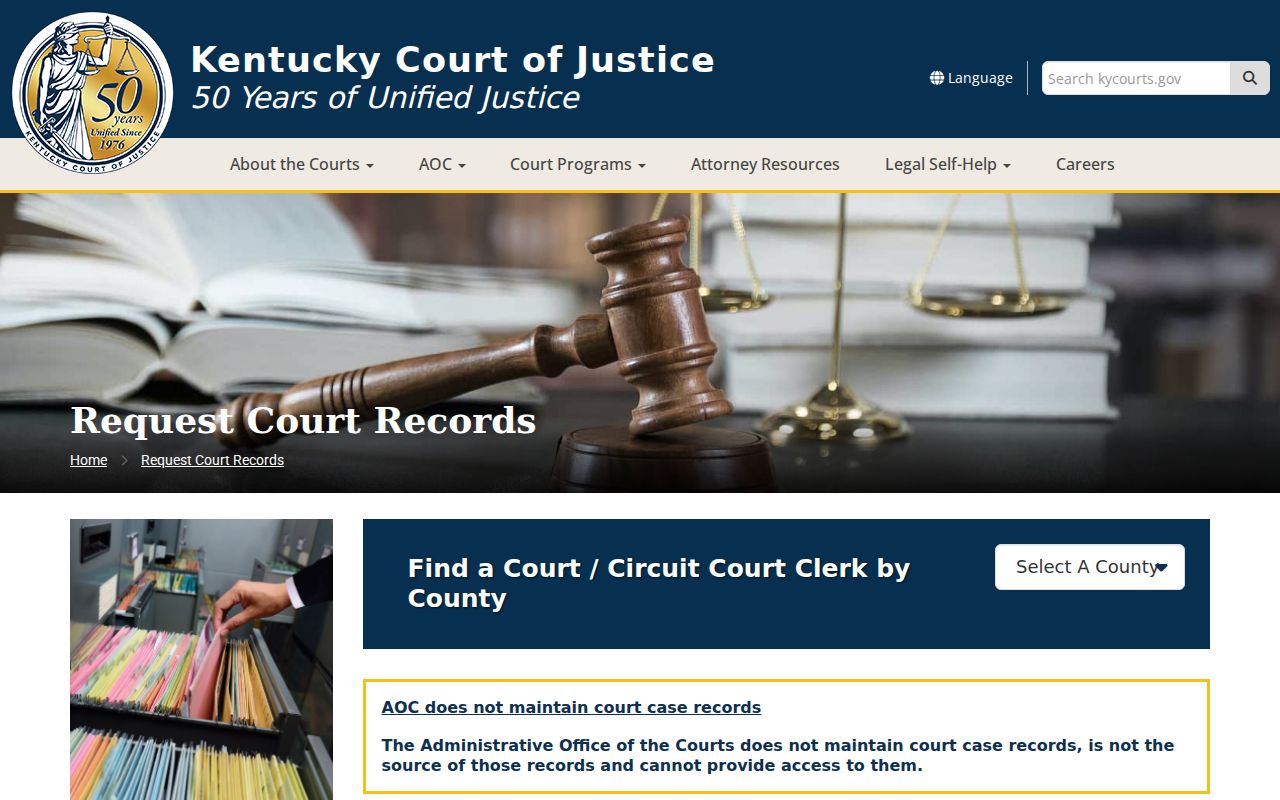
Its placement here marks the key distinction: use statewide search to find the lead, then use the Campbell clerk to obtain the controlling local record.
Criminal Case Stages in Campbell County
A criminal file changes as the case moves. District Court often receives the citation, complaint, or first post-arrest filing. The judge then addresses appearance and bond. In a felony matter, the preliminary stage may lead to a grand-jury decision and a new Circuit Court file. Motions, discovery disputes, competency issues, suppression questions, and continuances can add docket events without resolving guilt.
Case flow: Charges Filed › Arraignment › Pretrial › Plea or Trial › Disposition › Sentencing
A resolution may be a guilty plea, verdict, dismissal, acquittal, or another disposition. “Amended down” means the final charge differs from the original accusation. Sentencing may add confinement, probation, restitution, costs, or other terms. An appeal creates a separate appellate record, and later expungement proceedings should not be inferred from an empty portal result.
Kentucky sentencing classifications are governed by Chapter 532. The official Kentucky sentencing statutes are shown in the assigned Campbell County court case image.
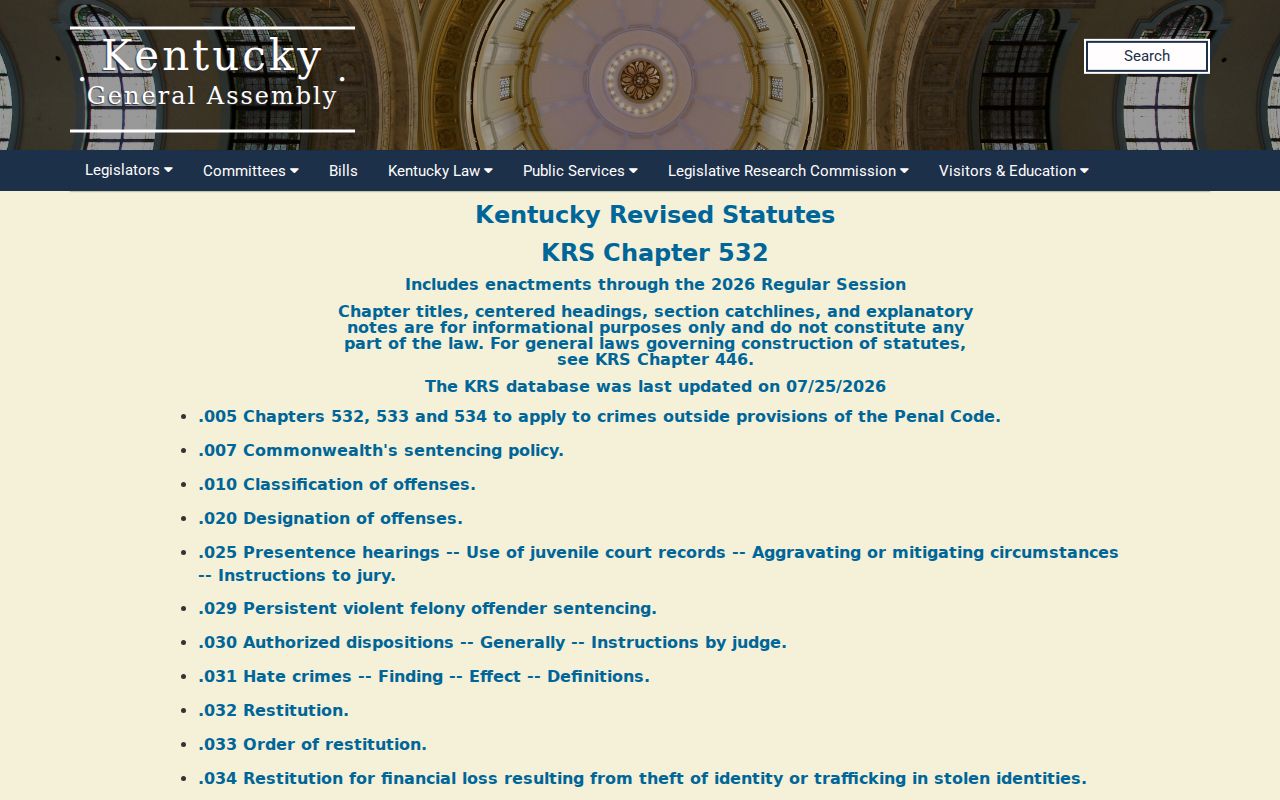
The statute page supplies legal context, but only the filed judgment shows which charge class and sentence the Campbell court actually imposed.
Campbell County Charging Paths
Campbell County divides prosecution by court level. The County Attorney handles county misdemeanors, including offenses such as DUI, assault, bad checks, and theft, while the Commonwealth's Attorney prosecutes felonies after indictment. The County Attorney Criminal Division is on the third floor of the Newport courthouse and lists 859-581-8015.
The assigned image captures the local prosecution contact source for Campbell County court cases.
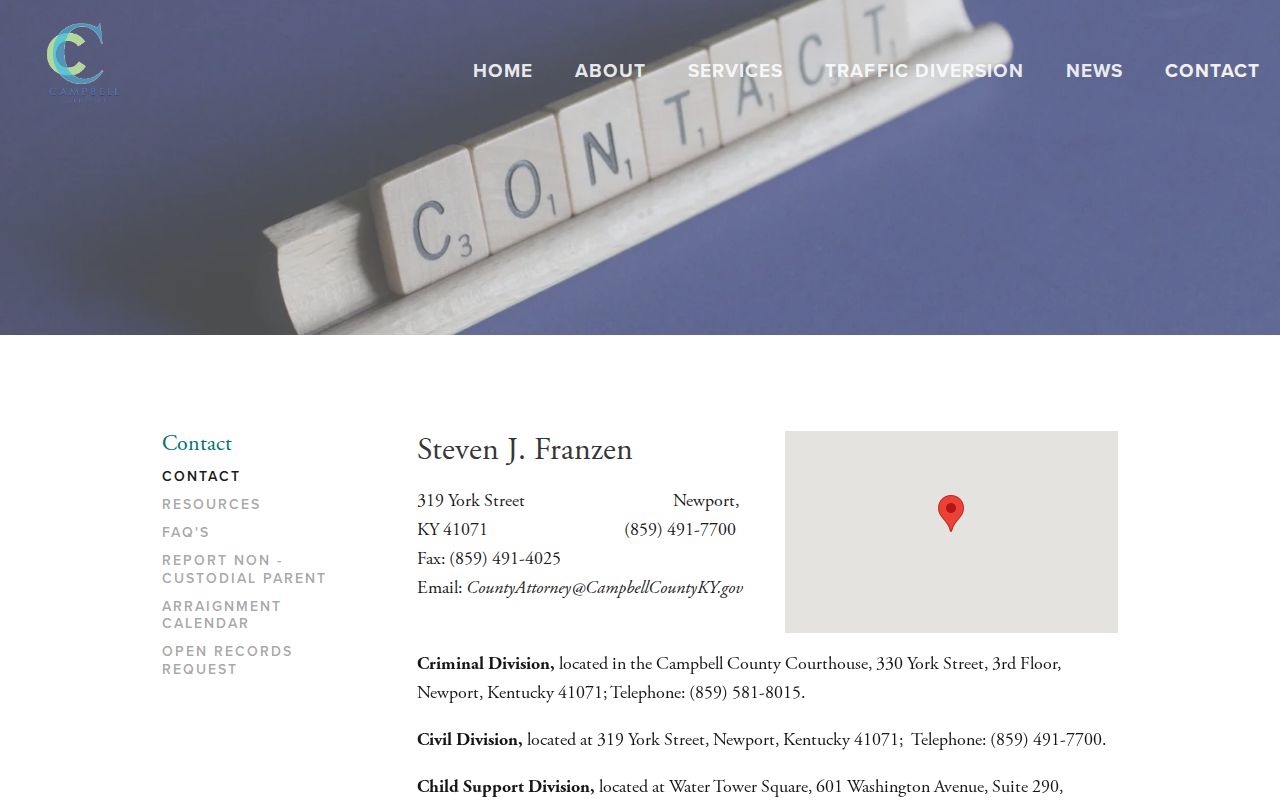
Use the prosecutor's office to understand its role, not as a substitute for the clerk. Filed charging documents, docket entries, orders, and judgments still come from the court record.
Older Campbell County Court Files
An old case may no longer sit at the public counter. The clerk can determine whether it remains in the office, has moved to a record facility, or was destroyed under an approved retention schedule. If the file went to the State Records Center, the Campbell clerk must first provide its case and file locator numbers. The state center cannot search transferred court files merely by a person's name or Social Security number.
Once the locator numbers are known, the research lists state.records@ky.gov and 502-564-3617 as the archive contacts. This is a fallback, not the first stop. Begin with 330 York Street even for a decades-old Campbell County case. The clerk is also the right place to ask whether a District F matter later produced a Circuit CR file.
Note: Preserve both District and Circuit numbers when reconstructing an older felony path through Campbell County courts.
Access Rules for Case Records
Kentucky court files use judicial access procedures. They are not obtained by sending an executive-branch open-record request to AOC. The clerk supplies public Campbell trial-court records, subject to court rules and restrictions. Juvenile and other confidential case types, protected identifiers, victim information, and expunged matters are withheld or redacted. A public online view may also contain less than the paper or imaged official file.
The Kentucky Open Records Act governs executive-agency records, and Campbell Fiscal Court's local policy routes judicial records elsewhere. The Court of Justice directs case requests to the circuit clerk. If a known case does not appear online, ask the clerk to check the exact name, date of birth, case type, and year. Absence from search does not establish that no case ever existed, nor does it prove that an expungement order was entered.
For the arrest and booking trail that precedes a filed case, use the separate Campbell County arrest search. The court page is the place to establish what charge proceeded and how it ended.